
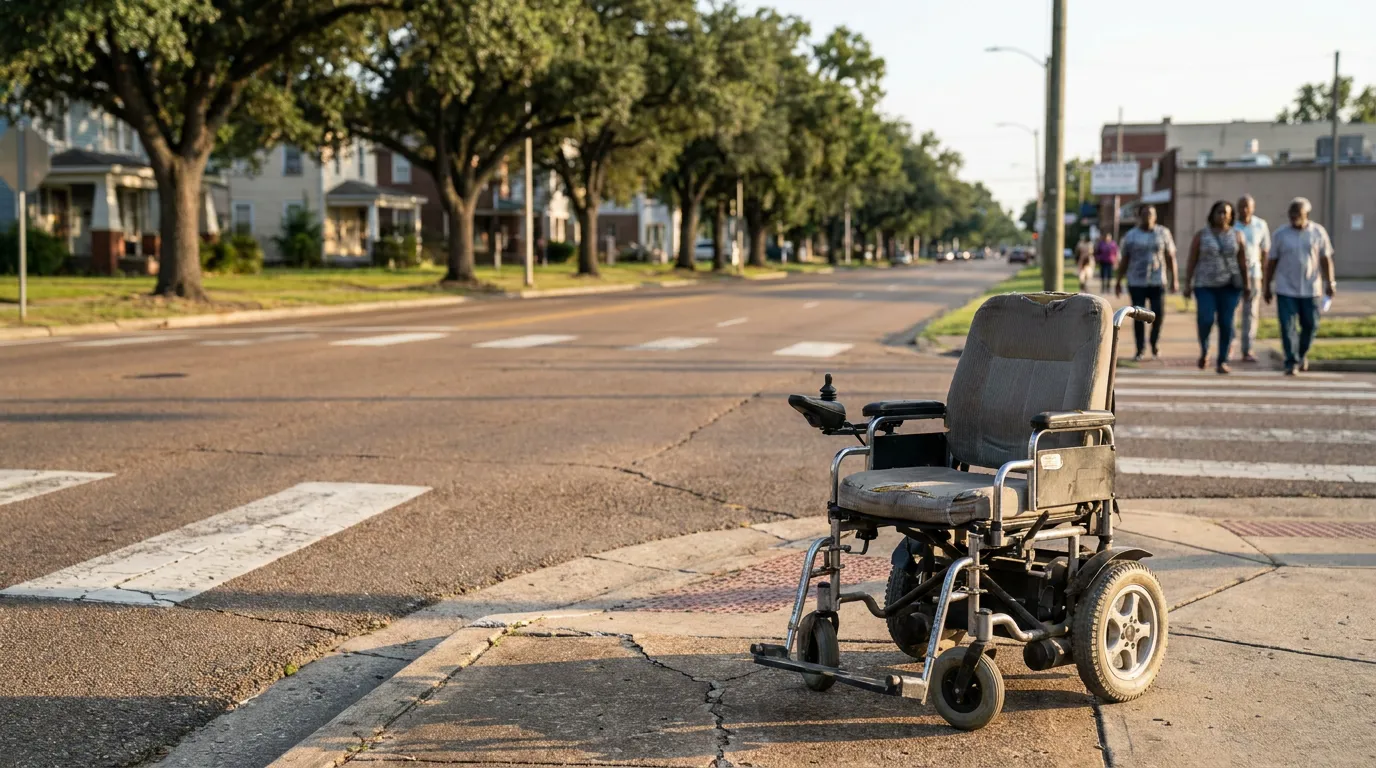
Fatal Medgar Evers Boulevard Crash Renews Focus on Jackson Pedestrian Safety
Key Takeaways: A wheelchair-using pedestrian killed by a vehicle on Medgar Evers Boulevard illustrates how Mississippi’s wrongful death law, found primarily in Miss. Code § 11-7-13, may allow a grieving family to seek accountability. The statute limits who may sue to a defined class of relatives and permits recovery even when death is instantaneous. Questions of negligence and contributory negligence generally go to a jury under Mississippi’s comparative fault framework. Recoverable damages can include funeral, medical, and other related expenses, whether or not an estate is opened. Filing deadlines for fatal-crash claims are fact-sensitive and should be confirmed early. This article explains the legal landscape and practical steps for affected families.
The death of a pedestrian using a wheelchair on Medgar Evers Boulevard is a devastating reminder that Jackson’s busy corridors can turn ordinary crossings into tragedies. For the family left behind, grief often arrives alongside urgent legal questions about accountability and financial survival. Understanding how Mississippi law treats a Medgar Evers Boulevard pedestrian crash can help loved ones make informed decisions during an overwhelming time.
This kind of loss matters deeply to Jackson residents because vulnerable roadway users have little protection against a negligent driver. A person in a wheelchair is a pedestrian under the law, not a vehicle, and depends on drivers honoring their duty of care. When that duty fails on a roadway like Highway 49 or Medgar Evers Boulevard, the consequences are frequently fatal, and the surviving family may have legal options worth exploring.
Understanding Mississippi’s Wrongful Death Law After a Fatal Crash
Mississippi’s wrongful death claims are governed principally by Miss. Code § 11-7-13, the controlling statute that frames who may recover after a fatal accident. Under this law, when a death is caused by a wrongful or negligent act or omission that would have entitled the injured person to sue had they lived, the at-fault party remains liable despite the death. Importantly, the statute makes clear that the fact death was instantaneous does not defeat the right of recovery, which is central to a wheelchair-pedestrian fatality claim.
The statute also defines the scope of what a jury may award in these cases. Subject to the provisions of Section 11-1-69, a jury may award damages it determines to be just, taking into consideration all damages of every kind to the decedent and to all interested parties. You can review the full text of the Mississippi wrongful death statute to see how broadly the law frames these categories, though how it applies always depends on the specific facts.
Who Can File a Wrongful Death Claim
Mississippi limits who may bring a wrongful death action to a defined and exclusive class of relatives. The statute allows an action by the widow, husband, child, father, mother, sister, or brother of the deceased, and this list of eligible persons is exclusive. A claim may be brought by the personal representative of the deceased for the benefit of all persons entitled to recover, or directly by a qualifying beneficiary.
Eligibility generally follows a statutory hierarchy that depends on the decedent’s family circumstances. In many cases, if the deceased was unmarried with no children, a surviving parent qualifies as a wrongful death beneficiary, and any siblings would also be beneficiaries. A helpful feature for grieving families is that any qualifying relative may bring an action outside an estate, regardless of whether the deceased left real or personal assets, subject to exceptions that a qualified attorney can review.
- Only one suit may be brought for the same death, filed for the benefit of all interested parties.
- Recoverable damages may include property damage plus funeral, medical, and other related expenses.
- A claim can proceed whether or not an estate has been opened.
- The jury generally decides negligence and contributory negligence, not the insurance company.
A Jackson Family’s Story: When a Wheelchair Crossing Turns Tragic
Imagine a Jackson mother whose adult son used a wheelchair and was struck and killed while crossing Medgar Evers Boulevard at dusk. He was unmarried and had no children, leaving his mother and one sister to absorb both the emotional and financial weight of the loss. In this hypothetical, both the mother and sister could fall within the class of statutory beneficiaries, though the precise analysis depends on the family’s full circumstances.
In the days after such a crash, families are often confronted by insurance adjusters before they have even planned a funeral. An adjuster might suggest the pedestrian was partly to blame for the collision, hoping to reduce or deny the claim. Under Mississippi law, however, that argument does not automatically end a case, because questions of negligence and contributory negligence are generally left to the jury to weigh.
How a Car Accident Lawyer Jackson Mississippi Families Trust Can Help
A car accident lawyer Jackson Mississippi families rely on can translate a confusing statutory framework into a practical roadmap. Mississippi follows a pure comparative fault approach under Miss. Code § 11-7-15, meaning a defense that the pedestrian shared some blame does not bar recovery; instead a jury weighs the conduct of each party and reduces any award in proportion to the decedent’s share of fault. You can read a general overview of how comparative negligence doctrines operate, keeping in mind that Mississippi’s specific application is fact-dependent and courts interpret each case on its own record.
Legal counsel can also help identify the correct filing deadline, which should never be assumed. Mississippi generally allows three years from the date of death to file a negligence-based wrongful death claim, but shorter periods can apply, such as one year when death results from an intentional act, so families should confirm the applicable deadline rather than presume one applies. Deadline exceptions are generally interpreted narrowly, and a civil statute of limitations differs from any administrative claim deadline that might apply if a government entity is involved, so early consultation is prudent.
Firms that handle these matters across the region bring unique knowledge of the law to pedestrian fatality cases. For families weighing their options, working with a trusted Jackson pedestrian fatality attorney can clarify right-of-way questions and liability under Mississippi statutes. Nothing here guarantees any particular outcome, because results always depend on the evidence and the specific facts of each case.
Proving Negligence and Damages in a Pedestrian Fatality Claim
Establishing a driver’s negligence is the heart of any pedestrian wrongful death Mississippi claim. Mississippi traffic law establishes pedestrians’ right-of-way at crosswalks that lack traffic control signals and imposes a duty on a vehicle approaching another vehicle stopped for a pedestrian. A violation of that duty can serve as strong evidence of at-fault driver liability in Jackson, though a jury ultimately evaluates the weight of that evidence.
Preserving documentation early can be significant to a family’s case. A Jackson Police Department crash report, witness statements, surveillance footage, and vehicle data may all help reconstruct what happened on Medgar Evers Boulevard. To understand what materials often matter most, families may find it useful to learn about the evidence in wrongful death cases before speaking with an insurer.
Evidence That Strengthens a Claim
Building a pedestrian negligence claim generally requires connecting the driver’s conduct to the fatal outcome. Photographs of the scene, the position of the wheelchair, roadway lighting, and any evidence of speeding or distraction can all be relevant. Because Mississippi assigns care obligations even to vulnerable roadway users in some contexts, an attorney will typically analyze how right-of-way rules apply to the specific location and time of day.
Damages evidence deserves equal attention. Funeral bills, medical expenses incurred before death, and documentation of the family’s losses may all factor into what a jury could consider just. Gathering and organizing these records early often strengthens a family’s position and reduces the risk of gaps later in the process.
How Does This Impact Me?
What Does Mississippi Law Mean for My Family’s Claim?
Mississippi’s wrongful death statute may allow certain relatives to seek compensation for a pedestrian death. Whether you qualify generally depends on your relationship to the deceased and the family’s structure. Because eligibility follows a statutory hierarchy with exceptions, confirming your standing with an attorney is a sensible first step.
Does It Matter If the Driver Claims the Pedestrian Was at Fault?
Not necessarily, because Mississippi treats negligence and contributory negligence as jury questions. Under the state’s pure comparative fault framework, a shared-fault argument does not bar recovery; instead, any award is reduced in proportion to the decedent’s assigned percentage of fault. In many cases, the jury weighs each party’s conduct rather than the insurer deciding the outcome.
How Long Do I Have to File?
Deadlines for fatal-crash claims are fact-sensitive and should be verified promptly. Mississippi generally gives three years from the date of death for negligence-based wrongful death claims, but shorter periods can apply, such as one year for deaths caused by intentional acts, so no deadline should be assumed automatic or unlimited. Courts interpret exceptions narrowly, so acting early helps protect your rights.
Do I Need to Open an Estate First?
Generally no, because a qualifying relative may bring a claim outside an estate. The law allows recovery whether or not an estate has been opened, and regardless of whether the deceased left assets. Still, certain situations may involve a personal representative, so individual guidance is wise.
What Should I Do Next?
Preserve every document and avoid giving recorded statements to adjusters before consulting counsel. Save the crash report, medical bills, and any photos or videos from the scene. Then consider speaking with a qualified attorney who can evaluate your specific circumstances.
Moving Forward After Loss
Losing a loved one in a Medgar Evers Boulevard pedestrian crash is a profound tragedy that no statute can undo. Mississippi law does, however, provide a framework through which certain family members may pursue accountability and compensation for damages such as funeral and medical expenses. Because every case turns on its own facts, the information here is general and should not be treated as individualized legal advice.
Families weighing their options do not have to navigate this process alone. A knowledgeable car accident lawyer Jackson Mississippi residents trust can explain your standing, help preserve evidence, and confirm the deadlines that apply to your situation, all while setting realistic expectations about the road ahead.
If you have questions after a fatal pedestrian crash, Mama Justice Law Firm is available to discuss how Mississippi law may apply to your circumstances. You can call [(833) 626-2587]((833) 626-2587) or contact us today to learn more about your legal options with a car accident lawyer Jackson Mississippi families can turn to for guidance.