
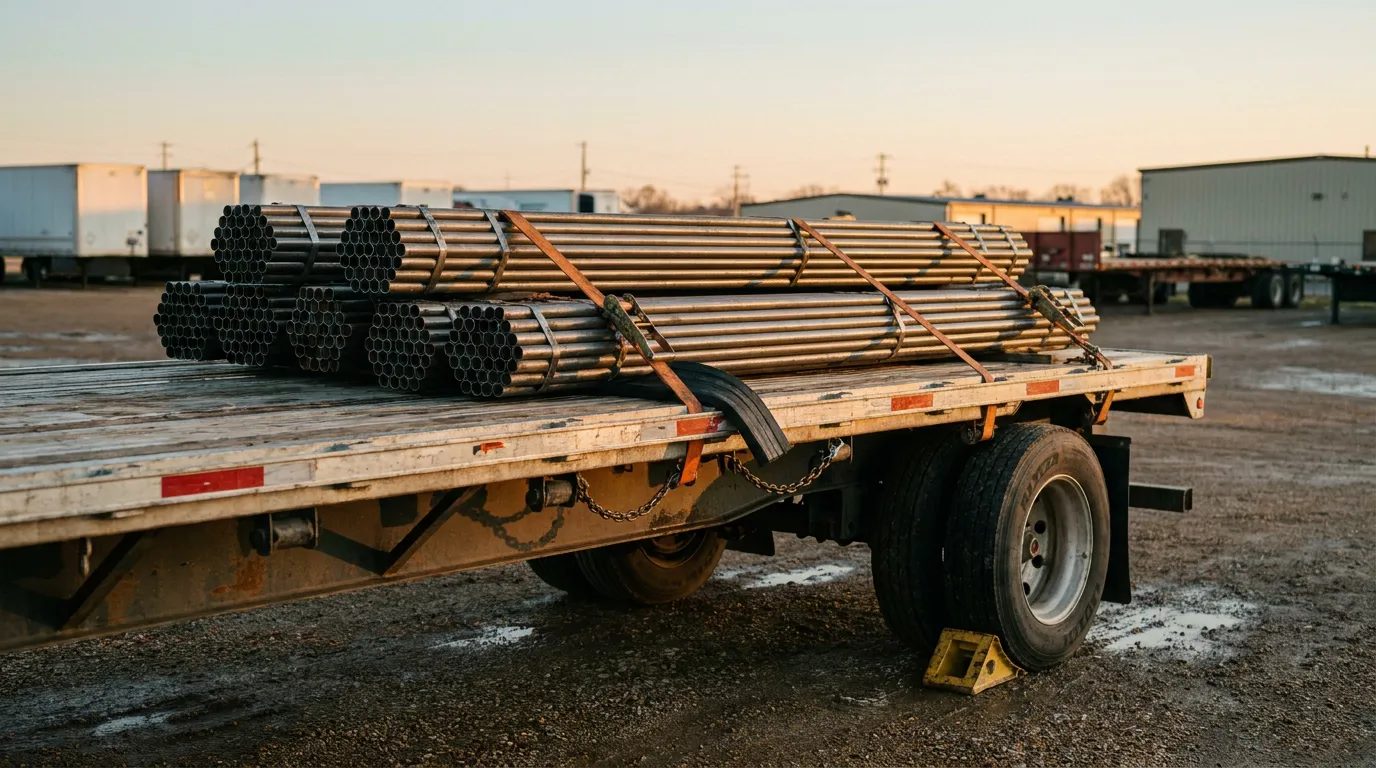
Why Cargo Securement Evidence Disappears Fast After a Jackson Semi-Truck Crash
Key Takeaways: Attorneys preserve cargo securement evidence by acting fast, because straps, chains, load photos, and trailer hardware degrade or disappear within days of a Jackson semi-truck crash. Federal cargo securement standards under 49 CFR Part 393 supply the measurable duty attorneys use to judge whether a carrier properly immobilized its load. Mississippi state law can add a second, independent layer of carrier duty, and its tort limitations period governs the window for preservation and filing. The central tool is a prompt spoliation letter directing the carrier to preserve the trailer, hardware, load records, and electronic logs before they vanish. Counsel then matches recovered tiedown counts, inspection reports, and load documents against the regulatory checklist to reconstruct how the cargo shifted. Every outcome depends on the specific facts, and this article is general information, not legal advice.
A shifted load can turn an ordinary highway into a catastrophe in seconds. When cargo breaks free from a flatbed or trailer near Jackson, the resulting collision often leaves families facing serious injuries, mounting medical bills, and urgent questions about what actually caused the load to fail. The evidence that answers those questions, from tiedown counts to strap conditions, begins deteriorating almost immediately after the crash.
For anyone injured by an 18-wheeler in Mississippi, understanding how counsel preserves this proof matters enormously. Cargo securement evidence preservation is time-sensitive work, and delay can permanently weaken an otherwise strong claim. This overview explains the governing standards, a realistic scenario, and the practical steps that shape a truck crash investigation.
The Federal and State Rules That Define a Carrier’s Duty
The starting point in nearly every cargo case is federal law. FMCSA maintains federal cargo securement standards under 49 CFR Part 393, Subpart I, which govern how cargo must be blocked, braced, and tied down on commercial motor vehicles.
These rules establish federal minimum standards requiring cargo to be firmly immobilized or secured to prevent shifting or falling during transport. You can review the agency’s plain-language summary of these obligations through the official federal cargo securement rules, which attorneys reference as the neutral compliance benchmark.
These federal minimums apply uniformly to interstate carriers moving through the region. Because FMCSA cargo securement rules are federally uniform, they apply to interstate carriers operating through Jackson, Mississippi, making this source directly relevant for establishing the legal standard attorneys use when arguing a securement violation caused a truck crash. That uniformity means a carrier hauling freight across state lines cannot claim ignorance of the baseline.
The rules are also highly technical, which is why they invite expert interpretation. They specify performance criteria, such as a minimum number of tiedowns based on cargo length and weight, that attorneys can compare against post-crash evidence like tiedown counts, strap conditions, and load photos to prove violations. FMCSA guidance further clarifies that securement devices must be inspected before and during transport, supporting arguments that a failure to conduct required inspections contributed to cargo shifting in a crash.
State law can add a second, independent layer of duty. Mississippi law imposes specific safety-equipment and marking requirements on vehicles hauling hazardous cargo, illustrating that state law, not just FMCSA regulations, can independently establish carrier duties relevant to cargo-related truck crash investigations in Jackson. The statute also authorizes the state commissioner to issue additional regulations for dangerous cargo transport, showing a regulatory framework attorneys can reference alongside federal rules when building an evidence-preservation letter to a carrier.
How FMCSA Cargo Securement Rules Truck Accident Evidence Builds a Claim
Proving a securement violation generally requires matching the physical scene against the regulatory checklist. The FMCSA cargo securement rules truck accident framework gives counsel a measurable standard: how many working tiedowns were present, what their aggregate working load limit was, and whether the load was blocked and braced. When the physical proof falls short of that standard, it can support an inference of negligence, though the ultimate question remains fact-dependent.
Industry organizations continue to refine these technical requirements. CVSA, which develops and enforces roadside inspection criteria including the North American Standard Out-of-Service Criteria, formally petitions FMCSA on cargo securement tiedown rules, indicating these requirements are actively contested and technically detailed enough to require careful interpretation in litigation. One such petition concerns aggregate working load limit requirements for tiedowns, a core technical element attorneys and accident reconstructionists examine to determine if a carrier met minimum securement standards.
Roadside inspection benchmarks frequently become evidence themselves. CVSA describes itself as a nonprofit organization comprised of local, state, provincial, territorial and federal commercial motor vehicle safety officials and industry representatives, whose mission is to improve commercial motor vehicle safety and enforcement by providing guidance, education and advocacy across North America, which includes developing the inspection procedures used in roadside enforcement. FMCSA cargo securement resources often include enforcement bulletins and inspection criteria used by roadside inspectors, which attorneys can cite to show industry-recognized benchmarks when preserving post-crash evidence.
Key Evidence Attorneys Move to Preserve Early
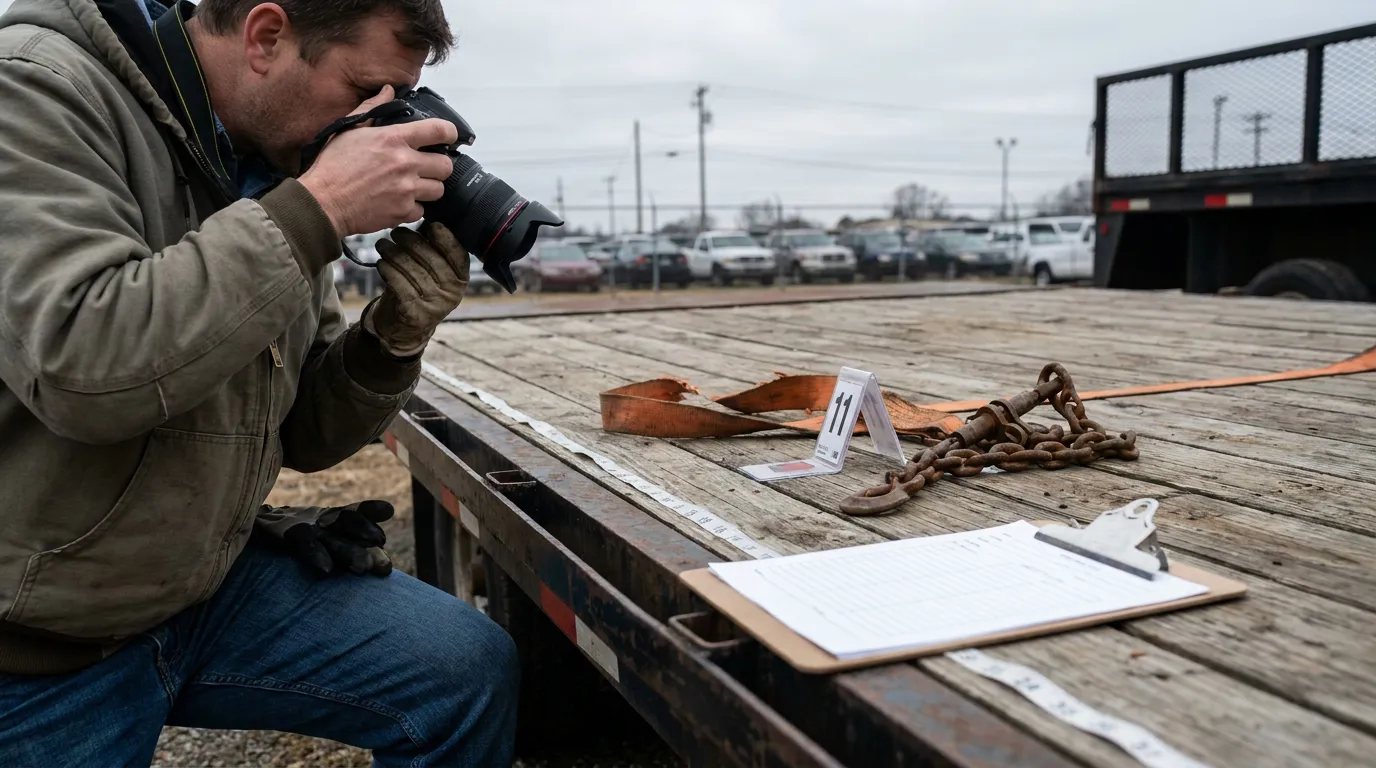
In a cargo case, the most persuasive proof is often the most perishable. Counsel typically acts quickly to document and secure the following before a carrier repairs, reloads, or scraps the equipment:
- Tiedown failure documentation, including the number, type, and condition of straps or chains
- Flatbed load records, bills of lading, and weight tickets showing how the freight was arranged
- Photographs of the load, trailer, and scattered cargo taken before cleanup
- Post-crash roadside inspection reports and any out-of-service citations
- Driver logs and pre-trip and en-route inspection entries
- The physical securement hardware itself, retained as tangible evidence
Each item connects the regulatory standard to what actually happened on the road. For example, comparing recovered strap counts against the minimum tiedown requirement can reveal whether commercial carrier liability may attach. Because carriers sometimes dispatch rapid-response teams to a wreck site, injured victims benefit from understanding what happens when a trucking company sends a truck crash investigation team to the scene.
A Jackson Scenario: When a Flatbed Load Comes Loose
Consider a driver commuting home on I-20 near Jackson when steel coils slide off a flatbed ahead. The load strikes her vehicle, causing severe injuries and totaling her car. In the chaos, the carrier’s equipment is towed away, straps are discarded, and the trailer is back in service within a week.
In this situation, the family’s ability to prove a violation may hinge on speed. Their attorney would generally send a spoliation letter directing the carrier to preserve the trailer, hardware, load records, and electronic logs before that proof vanishes. The FMCSA cargo securement rules truck accident standard would then frame whether the recovered tiedowns met the minimum required for the coils’ length and weight.
The scenario also shows how fault can be shared. Mississippi follows a pure comparative fault approach, and understanding how comparative negligence allocates responsibility helps injured people see why documenting the carrier’s share of fault is so important. Recovery may be reduced by a victim’s own percentage of fault, so thorough documentation of the carrier’s securement failures can matter significantly.
Deadlines, Spoliation, and Practical Timing
Mississippi law sets the outer boundary for these claims. For most negligence-based personal injury claims arising from a semi-truck crash, Mississippi’s general three-year statute of limitations under Section 15-1-49, titled "Limitations applicable to actions not otherwise specifically provided for," is the statutory backbone for timing an attorney’s evidence preservation efforts and eventual filing deadline after a cargo securement failure. Because the applicable limitations period can vary with the specific claim and parties involved, injured people should confirm their exact deadline early rather than assume one applies.
Courts generally interpret exceptions to filing deadlines narrowly. Tolling or discovery-based extensions may apply only in limited circumstances and are never automatic, so relying on a possible extension is risky. Government-related claims can also carry separate administrative notice deadlines that differ from the civil limitations period.
Why Early Action Protects the Evidence
A well-timed spoliation letter is often the single most effective preservation tool. It puts the carrier on notice that destroying relevant proof could carry legal consequences, and it identifies the specific records and hardware at issue. The sooner this letter goes out, the less opportunity a carrier has to alter the scene.
How Does This Impact Me?
What Does This Mean for My Cargo Crash Case?
It generally means the federal securement standard gives you a concrete way to measure a carrier’s conduct. If the recovered tiedowns or load records fall short of the required minimum, that gap may support your claim. Whether it does depends on the full factual record.
Does a Shifted Load Change My Filing Deadline?
Not by itself. The Mississippi limitations period for tort claims still governs, and courts apply any exceptions narrowly and case by case. You should verify your specific deadline promptly, because certain claims and defendants can carry different or shorter notice requirements.
What Should I Do to Preserve Evidence Right Now?
Act quickly to prevent the loss of perishable proof. Photograph the scene if you safely can, keep any documents you received, and seek counsel who can issue a preservation demand before the trailer is repaired or reloaded. Prompt spoliation truck evidence measures are difficult to replicate later.
Who Might Be Liable Besides the Driver?
Liability can extend well beyond the person behind the wheel. Depending on the facts, the motor carrier, the cargo loader, or a maintenance provider may share responsibility. Identifying every potentially liable party early supports a fuller recovery.
Where Can I Learn More About Truck Crash Representation?
You can review how these cases are handled from the injured person’s perspective. A dedicated Jackson truck accident lawyer resource explains the process for pursuing commercial carrier claims. Every case turns on its own facts, so individualized guidance is important.
Bringing the Standards and the Evidence Together
The lesson for injured Mississippians is that cargo cases are won or lost on preservation and precision. Federal securement rules supply the measurable duty, state law can add independent obligations, and the physical proof that ties them together degrades quickly. Moving early to document tiedowns, load records, and inspection reports gives an injured person the strongest foundation the facts will allow.
Because these matters are technical and time-sensitive, general information is no substitute for a case-specific review. Outcomes depend on the evidence, the parties, and how the governing standards apply to your particular crash.
If a shifted or unsecured load has upended your life, help is available. Mama Justice Law Firm offers to review your situation and explain your options. You can call [(833) 626-2587]((833) 626-2587) or contact us today to discuss how cargo securement evidence preservation may apply to your case.