
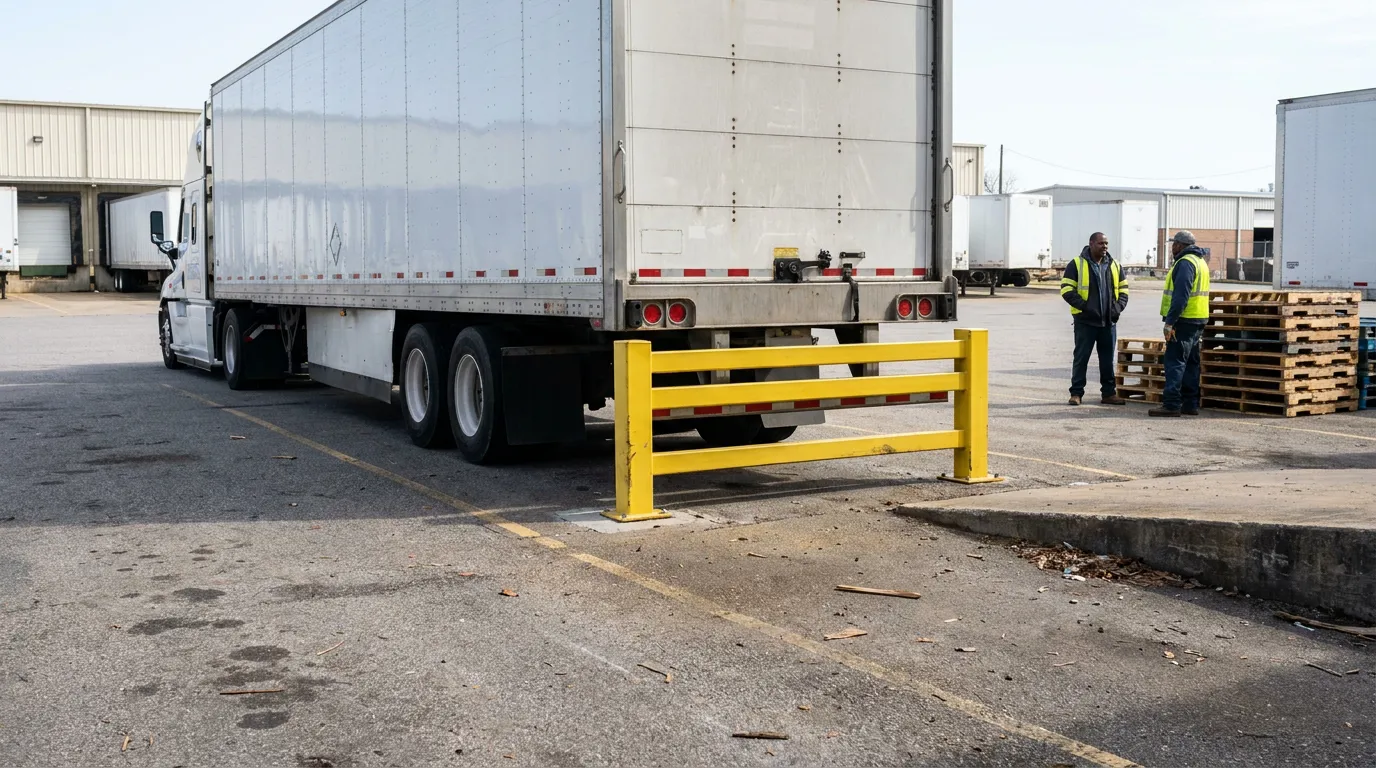
The Steel Bar That Should Have Stopped the Trailer
Key Takeaways: FMVSS 223 sets federal performance requirements for rear impact guards on large trailers, while FMVSS 224 requires qualifying trailers (GVWR 4,536 kg or more) to have compliant guards installed per manufacturer’s instructions. In Memphis truck crash claims, a missing, defective, or improperly mounted guard can support product liability and negligence theories against carriers, manufacturers, or maintenance providers, though federal standards create no private right of action. Defense counsel often cite exemptions for pole trailers, pulpwood trailers, low chassis vehicles, and certain hazmat tankers. Tennessee reinforces federal requirements through Tenn. Code Ann. § 65-15-111 and § 55-9-212. Trailer evidence disappears quickly, making prompt spoliation letters, scene photographs, and reconstruction inspection critical. Tennessee’s modified comparative fault rule and short filing deadlines affect recovery.
When a passenger car strikes the back of an 18-wheeler, the outcome often depends on the rear impact guard bolted beneath the trailer. FMVSS 223 sets federal performance requirements, and its companion rule requires guards on most large trailers. In a Memphis semi-truck accident, whether that guard was compliant, properly installed, or missing can affect recovery.
If you or a loved one was hurt in a rear-end collision with a tractor-trailer, the trailer’s equipment history deserves a hard look. Mama Justice Law Firm represents injured people and grieving families across Shelby County, never the carriers or their insurers. Call (833) 626-2587 or contact us now to discuss preserving trailer maintenance and inspection records before they disappear.

What the Rear Underride Guard FMVSS 223 Standard Actually Requires
FMVSS 223 and FMVSS 224 work as a matched pair. Standard 223 establishes strength and energy-absorption performance requirements for guard hardware, while Standard 224 governs installation. Under 49 CFR § 571.224, S1, the installation rule applies to trailers with a gross vehicle weight rating of 4,536 kg (roughly 10,000 pounds) or more manufactured on or after the standard’s effective date.
The regulation states its safety purpose plainly. Per 49 CFR § 571.224, S2, the standard exists to reduce deaths and serious injuries when light duty vehicles strike the rear of trailers at or above that weight rating. That purpose can support a safety-statute duty argument in negligence claims. The federal motor vehicle safety statute creates no private cause of action, so recovery must come through state-law negligence or product liability theories, with Tennessee courts determining whether the standard sets the standard of care.
Installation Instructions Create a Separate Theory of Liability
A guard can be perfectly manufactured and still fail because someone mounted it wrong. The installation rule ties compliance to guard installation instructions required by S5.5 of § 571.223. That linkage may open claims against trailer manufacturers, upfitters, or maintenance providers that deviated from manufacturer’s procedures, separate from defective design claims. Product liability claims in Tennessee are governed by the Tennessee Products Liability Act, which carries its own defenses and limitation periods, including statutes of repose in Tenn. Code Ann. § 29-28-103.
Measuring the "Rear Extremity" Is Technical Work
Accident reconstruction professionals determine where the trailer’s rear extremity legally begins. The rule defines that term by reference to measured horizontal planes, including one 1,900 mm above the ground, and excludes non-structural protrusions like tail lamps, rubber bumpers, hinges, and certain aerodynamic devices.
Because these exclusions are technical, scene photographs rarely settle the question. A qualified reconstruction professional may need to inspect the actual trailer, which is why early preservation demands matter.
Exemptions Defense Counsel Will Raise First
Not every trailer on Interstate 40 must carry a rear impact guard. The application section of 49 CFR § 571.224, S3 excludes several categories, so identifying trailer type is critical. The full text of the trailer safety regulation lists these carve-outs.
Excluded categories include:
- Pole trailers and pulpwood trailers
- Low chassis vehicles and wheels back vehicles
- Road construction controlled horizontal discharge trailers
- Special purpose vehicles
- Temporary living quarters units
There is also a partial carve-out for certain hazardous materials tankers. Cargo tank motor vehicles certified for hazmat transport that carry a rear bumper or rear end protection device conforming to 49 CFR part 178 in the horizontal member area are exempt only from the energy absorption requirement (S5.2.2) of 49 CFR § 571.223, they are still required to be equipped with a compliant rear impact guard. Given Memphis freight corridors’ chemical and fuel tanker traffic, this partial exemption surfaces frequently. An exemption from one performance sub-requirement of the federal standard is not a defense to the overall guard requirement, and carriers still owe a duty of reasonable care in how trailers are equipped, maintained, and operated.
How Tennessee Law Reinforces the Federal Rear Impact Guard Standard
Tennessee does not leave commercial trailer safety entirely to Washington. Under Tenn. Code Ann. § 65-15-111(a), the Department of Safety must promulgate safety rules governing the safe operation and equipment use by permit holders and operators of motor vehicles in commerce with a GVWR or GCWR of 10,001 or more pounds, capturing most tractor-trailers in Memphis crashes.
The statute reaches trailers directly and incorporates the federal scheme. Subsection (d) places trailers and semi-trailers under Department of Safety jurisdiction, with penalties for violators. Subsection (f) references federal motor carrier safety regulations at 49 CFR parts 390-397, but exempts commercial motor vehicles operated in intrastate commerce with a GVWR or GCWR of 26,000 lbs. or less from those federal regulations, with a limited exception allowing a Level I-trained Tennessee highway patrol officer to stop such vehicles for inspection upon probable cause of unsafe loading or mechanical conditions.
Rear Equipment Requirements Under State Law
Tennessee separately mandates rear-mounted protective equipment. Under Tenn. Code Ann. § 55-9-212(a), motor vehicles above specified carrying capacities must be equipped with rear fenders, mudflaps or mudguards to substantially prevent projecting rocks, dirt, water or other substances to the rear. Under subsection (c), a violation is a Class C misdemeanor.
That criminal classification shows Tennessee treats non-compliant rear truck equipment as an enforceable safety offense. However, § 55-9-212 addresses debris and spray, not underride protection. Under Tennessee law, negligence per se requires that the injured person belong to the protected class and that the injury be of the type the statute intended to prevent, so a mudflap violation rarely supports negligence-per-se in underride cases. Violations of federal guard and maintenance requirements are the stronger vehicle for that argument.
| Authority | What It Governs | Why It Matters in a Claim |
|---|---|---|
| 49 CFR § 571.223 | Guard performance requirements | Defect and design theories |
| 49 CFR § 571.224 | Guard installation on trailers ≥ 4,536 kg | Missing or misinstalled guard |
| Tenn. Code Ann. § 65-15-111 | State CMV safety rulemaking | Ties state enforcement to federal rules |
| Tenn. Code Ann. § 55-9-212 | Rear fenders, mudflaps, mudguards | Limited: aimed at road spray, not underride |
Building the Evidence Record After a Memphis Underride Crash
Trailer evidence can disappear within days. Carriers may repair damaged guards, rotate trailers back into service, and overwrite electronic data on ordinary retention schedules. A prompt spoliation letter demanding preservation of the trailer, guard hardware, maintenance files, and electronic logging device data can be among the most valuable early steps. In Tennessee, sanctions for spoliation require a showing of prejudice, so written preservation demands and their timing carry real weight.
💡 Pro Tip: Photograph the underside of the trailer’s rear, including bolt holes, weld lines, or bent members, before the vehicle leaves the scene or impound lot. Those images often anchor later measurement analysis.
Reporting obligations generate useful documentation. Understanding DOT recordable accident reporting requirements helps identify which internal records a carrier likely created after the collision, which sometimes contradict positions the carrier takes in litigation.
Fault Allocation Can Reduce What You Recover
Even strong guard-defect cases may be reduced by the injured party’s conduct. Tennessee follows a modified comparative fault system: a plaintiff’s damages are reduced in proportion to that plaintiff’s share of fault, and recovery is barred entirely if the plaintiff is 50 percent or more at fault. Insurers often argue speed, following distance, or inattention to shift percentages away from the carrier. That is not a reason to abandon a claim, but a reason to develop mechanical evidence thoroughly.
When a Government Vehicle Is Involved
Claims against governmental entities follow different rules and limits. Under Tenn. Code Ann. § 29-20-403(b)(4), for actions arising on or after July 1, 2007, required insurance must provide minimum limits of $300,000 per person, $700,000 per accident, and $100,000 for property damage. These are insurance minimums separate from damages caps and immunities in the Governmental Tort Liability Act, and governmental claims are subject to distinct procedures and a one-year limitation period.
Frequently Asked Questions
1. Does every semi-trailer in Memphis have to have a rear underride guard?
No. The installation requirement generally applies to trailers with a GVWR of 4,536 kg or more manufactured on or after the standard’s effective date, with exemptions for pole trailers, pulpwood trailers, low chassis vehicles, special purpose vehicles, and certain hazmat cargo tank vehicles with conforming rear end protection devices.
2. What is the difference between FMVSS 223 and FMVSS 224?
Standard 223 sets performance requirements for the guard hardware, and Standard 224 requires qualifying trailers to have a guard installed per the installation instructions required by S5.5 of § 571.223.
3. Can a missing rear guard alone establish the carrier’s liability?
Not automatically. A violation may support a negligence argument, but duty, causation, and damages require proof, and Tennessee’s modified comparative fault rule may reduce or bar recovery.
4. Who besides the trucking company might be responsible?
Potential defendants may include the trailer manufacturer, guard component manufacturer, maintenance provider, or lessor. Identifying correct parties early is important because Tennessee generally allows only one year to file a personal injury action, and product liability claims carry additional repose deadlines.
5. What should I preserve immediately after the crash?
Photographs of the trailer’s rear underside, the crash report, medical records, and any dashcam footage. Counsel can then send preservation demands for maintenance files, inspection reports, and ELD data.
Where This Leaves Injured Memphis Families
Underride collisions produce some of the most severe injuries on Tennessee highways, and legal analysis often turns on technical details. Federal standards define what the guard must do and which trailers must have one. Tennessee statutes layer state enforcement on top of that framework. Outcomes depend on the specific facts, trailer type, and evidence preserved in the first weeks.
Our team is backed by more than 75 years of combined legal experience, and we have helped over 3,500 families protect what matters most to them. If you are evaluating a claim, a rear underride guard fmvss 223 lawyer can review trailer specifications and equipment records alongside your medical documentation. Reach Mama Justice by calling (833) 626-2587 or request a case review today.
Disclaimer: This content is for informational purposes only and is not legal advice. Every case is unique, and results may vary. Consult an attorney about your specific circumstances.